

In modern electronics manufacturing, a printed circuit board assembly is not fully protected after soldering and assembly. Moisture, dust, salt spray, chemical contamination, temperature changes, and vibration can all affect the reliability and service life of electronic products.
This is where the conformal coating process becomes essential. By applying a thin protective film onto the PCBA surface, conformal coating helps protect electronic circuits from harsh environments while maintaining electrical insulation and long-term reliability.
For products used in automotive electronics, industrial control, home appliances, medical devices, renewable energy, communication equipment, LED electronics, and outdoor electronics, conformal coating is no longer an optional process. It has become a critical step for improving product reliability and reducing field failure risk.
1. What Is Conformal Coating?
Conformal coating is a specially formulated protective material applied to printed circuit boards. Common coating materials include acrylic, silicone, polyurethane, epoxy, and UV-curable coatings.
After application and curing, the coating forms a transparent or semi-transparent protective film over the PCBA surface. This film helps protect the circuit board from moisture, dust, salt spray, mold, chemical corrosion, electrical leakage, and environmental stress.
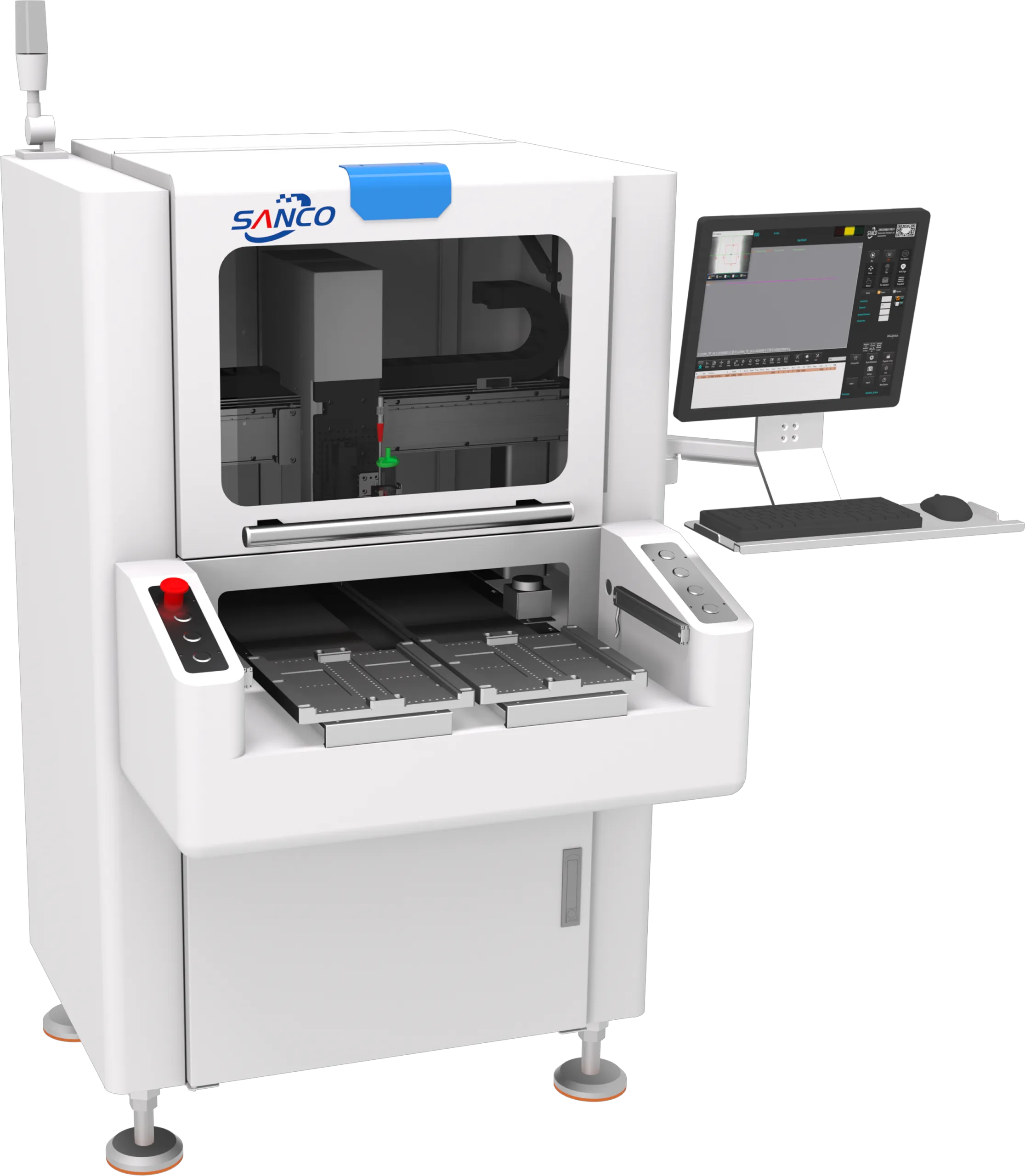
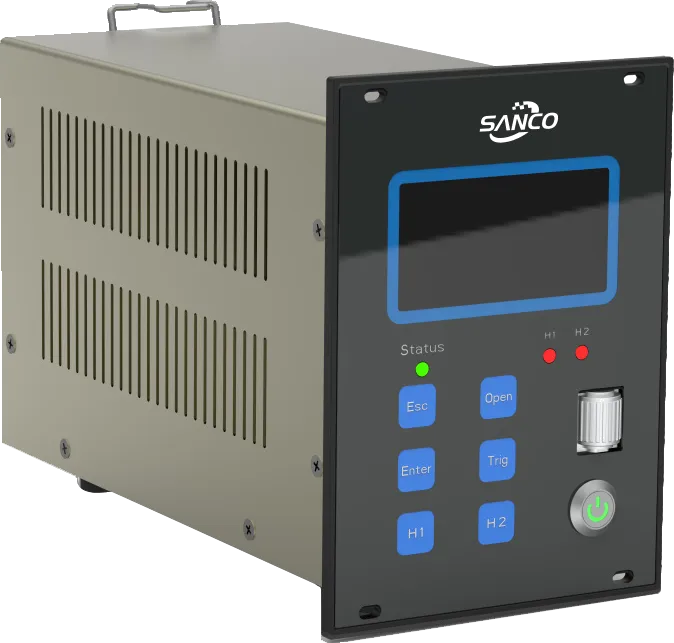
In practical PCBA manufacturing, conformal coating is often combined with an automatic Coating Machine, precision Kleppen coaten, inline Hardingsoven, and related Randapparatuur to build a stable automated coating line.
2. Why Is Conformal Coating Important for PCBAs?
Electronic products are becoming smaller, denser, and more complex. At the same time, they are expected to operate reliably in more demanding environments. Without proper protection, PCBAs may suffer from corrosion, leakage current, short circuits, insulation failure, or premature component damage.
A well-controlled conformal coating process helps manufacturers improve:
- Moisture and humidity resistance
- Salt spray and corrosion protection
- Electrical insulation performance
- Long-term product reliability
- Production consistency and quality control
- Failure risk reduction in harsh environments
For automotive electronics, industrial control boards, power modules, communication equipment, and outdoor electronics, conformal coating is especially important because these products often face humidity, dust, temperature changes, and chemical exposure during long-term operation.
3. Main Conformal Coating Methods
There are several ways to apply conformal coating to a PCBA. The most common methods include brushing, dipping, manual spraying, and automatic selective spraying. Each method has different advantages and limitations.
3.1 Brushing
Brushing is one of the simplest coating methods. It is often used for repair, prototyping, or small-batch production. Operators apply the coating manually with a brush. This method has low equipment cost, but it depends heavily on operator skill and is not suitable for high-volume production.
3.2 Dipping
Dipping means immersing the entire circuit board into a coating tank. It can cover the board surface completely, but it is difficult to control local coating areas, coating thickness, and material consumption.
3.3 Manual Spraying
Manual spraying is more flexible than brushing and can be used for medium-volume production. However, coating consistency, overspray control, and edge accuracy still depend on operator experience.
3.4 Automatic Selective Spraying
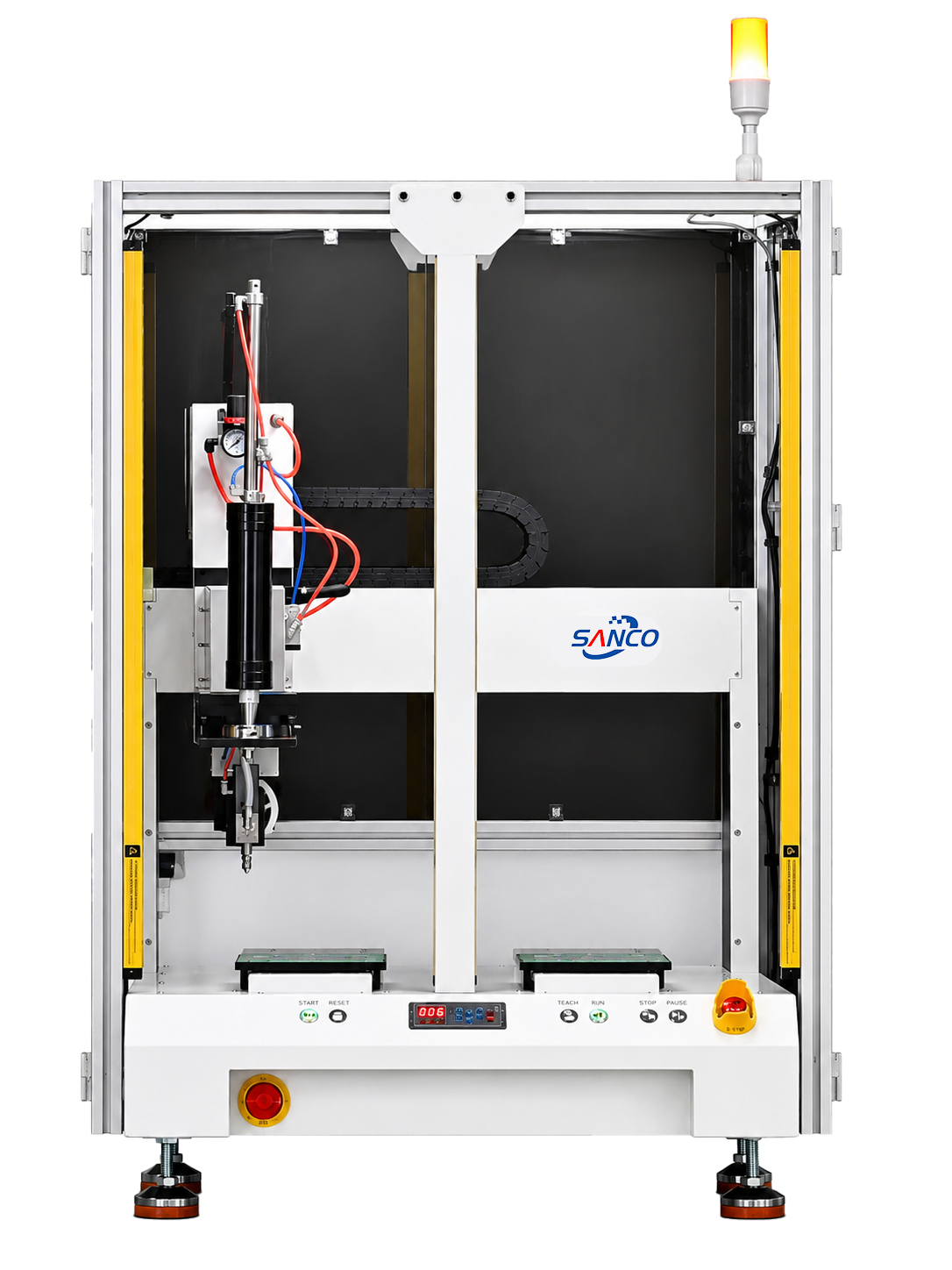
Automatic selective conformal coating is currently one of the most effective methods for high-volume PCBA production. The machine applies coating only to required areas and avoids sensitive components such as connectors, switches, sockets, and test points.
| Coating Method | Suitable Application | Main Advantage | Limitation |
|---|---|---|---|
| Brushing | Repair, prototype, small batch | Low cost and simple operation | Low efficiency and poor consistency |
| Dipping | Full-board protection | Complete coverage | Difficult local control and high material waste |
| Manual Spraying | Medium-volume production | Flexible operation | Operator-dependent quality and overspray risk |
| Selective Spraying | High-volume PCBA production | High precision, stable quality, less masking | Requires automatic coating equipment investment |
4. Standard Conformal Coating Process Flow
A reliable conformal coating process is not just about applying coating material. It includes cleaning, masking or selective protection, coating application, curing, inspection, and quality verification.
| Process Step | Main Purpose | Key Control Points |
|---|---|---|
| PCBA Cleaning | Remove flux residue, oil, dust, and contamination | Surface cleanliness, drying time, residue control |
| Pre-Baking | Remove moisture from PCB and components | Temperature, time, board material compatibility |
| Masking / Selective Avoidance | Protect areas that must not be coated | Connectors, switches, sockets, test points, screw holes |
| Coating Application | Apply coating to required PCBA areas | Valve type, coating path, speed, flow rate, spray width |
| Genezen | Solidify the coating and form final protection | UV intensity, oven temperature, curing time, conveyor speed |
| Inspectie | Verify coating coverage and quality | Visual inspection, UV check, thickness measurement |
5. Key Parameters in Automatic Selective Coating
For automatic selective coating, process stability depends on both equipment performance and parameter control. A small change in valve height, pressure, material viscosity, or coating speed may affect the final coating result.
The most important parameters include:
- Coating path: Defines where the coating is applied and helps avoid restricted areas.
- Valve type: Controls spray pattern, coating width, edge definition, and material output.
- Coating speed: Affects coating thickness and surface uniformity.
- Material flow rate: Controls coating volume and material consumption.
- Atomization pressure: Influences spray stability and overspray control.
- Valve height: Affects spray width, edge control, and coating accuracy.
- Board positioning accuracy: Prevents coating offset and accidental coating of keep-out areas.
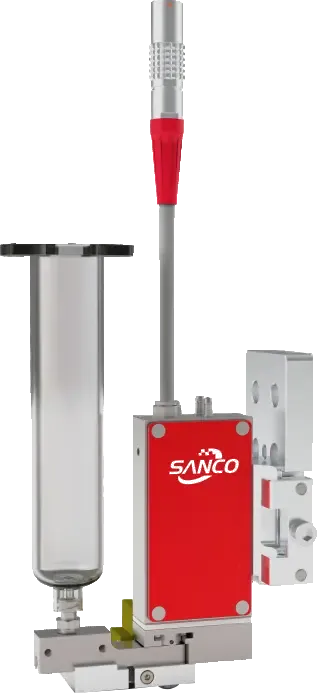
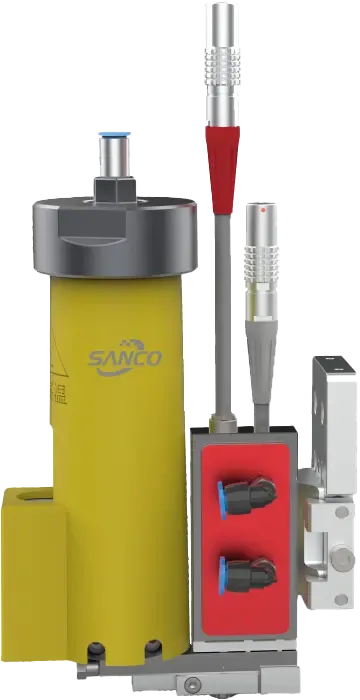
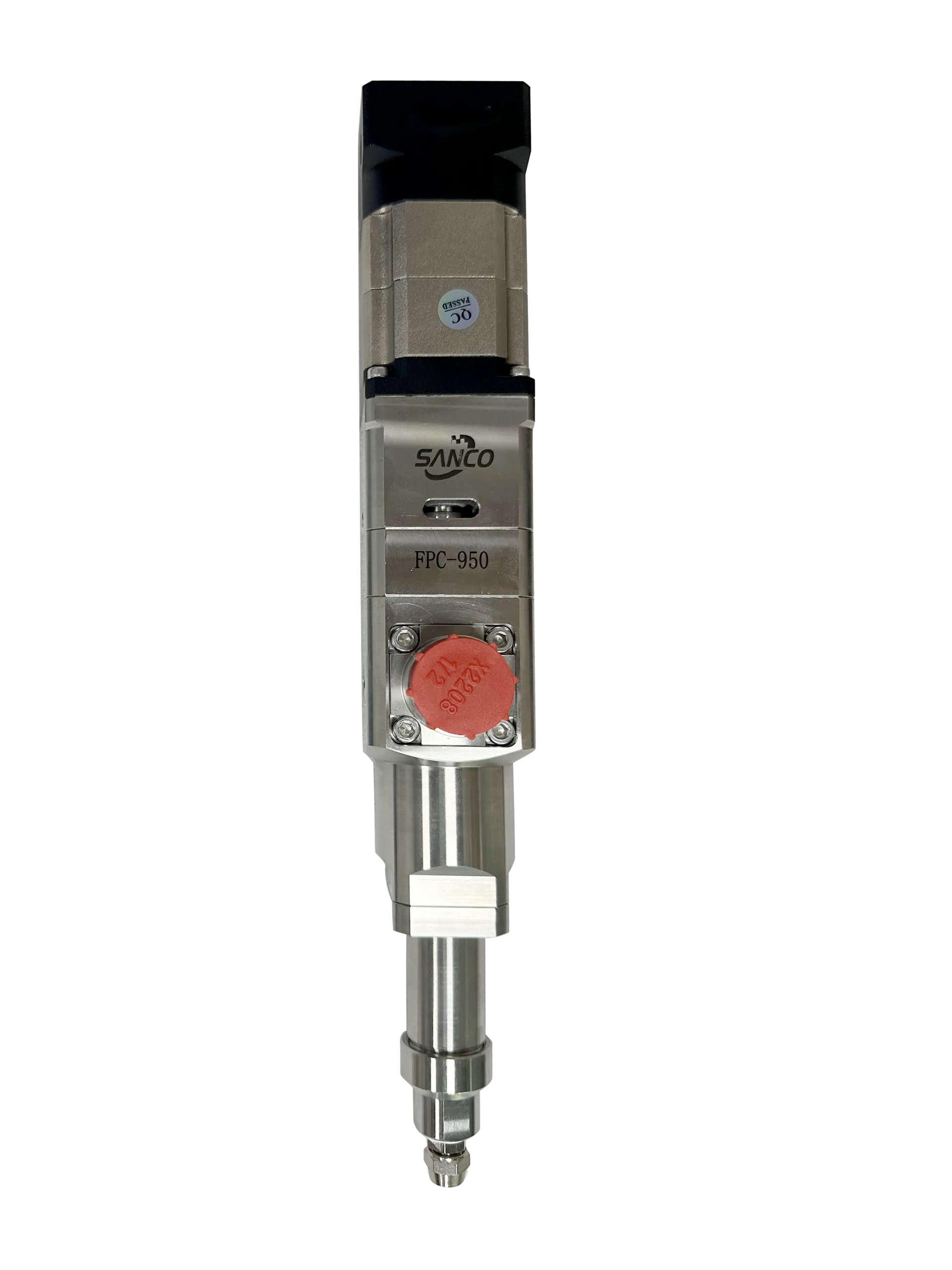
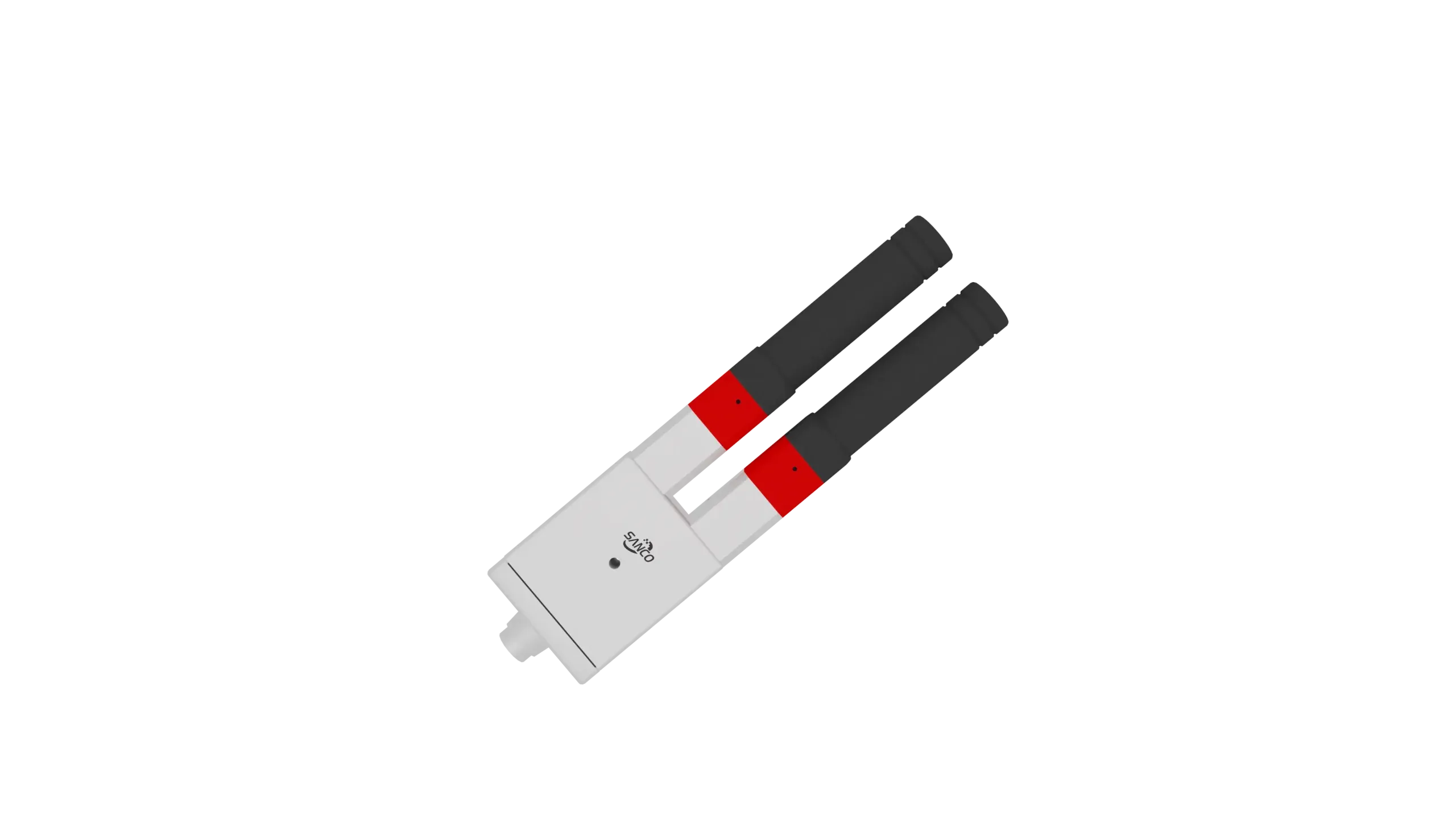
For different materials and coating patterns, manufacturers may use different Kleppen coaten, such as diaphragm valves, film spray valves, sector spray valves, striker valves, or conical spray valves.
6. Technical Requirements for Conformal Coating
To achieve stable coating quality, manufacturers need to control coating thickness, environmental conditions, material viscosity, curing conditions, and coating accuracy.
Common technical requirements include uniform coating thickness, stable temperature and humidity, proper material viscosity, accurate keep-out control, and complete curing. If these factors are not controlled properly, defects such as bubbles, pinholes, whitening, dripping, uneven coating, or incomplete curing may occur.
7. Common Conformal Coating Defects and Causes
Even a small process error can lead to coating defects. Understanding common coating problems helps manufacturers improve process control and reduce product failure risks.
| Defect | Possible Cause | Recommended Solution |
|---|---|---|
| Bubbles | Moisture, contamination, trapped air, excessive coating speed | Improve cleaning and drying, adjust spray parameters, control humidity |
| Pinholes | Surface contamination, poor wetting, improper viscosity | Clean PCBA surface, optimize material viscosity, adjust coating method |
| Uneven Coating | Unstable spray pattern, incorrect valve height, inconsistent speed | Optimize valve height, coating speed, pressure, and spray width |
| Whitening / Cloudy Film | High humidity, moisture absorption, unsuitable curing condition | Control environment humidity, pre-bake PCBAs, verify curing process |
| Dripping / Flow Marks | Excessive coating volume, low viscosity, slow movement speed | Reduce flow rate, adjust viscosity, optimize coating path |
| Overspray | Improper nozzle angle, excessive atomization pressure, poor path control | Use selective coating path, adjust atomization, improve fixture positioning |
8. Areas That Should Not Be Coated
Although conformal coating protects most of the PCBA surface, some components must remain uncoated. If these areas are coated, it may affect electrical connection, mechanical assembly, optical performance, heat dissipation, or future maintenance.
Typical keep-out areas include connectors, sockets, switches, potentiometers, test points, screw holes, heat sinks, LEDs, optical components, and some low-clearance BGA or QFN areas. These areas can be protected by selective coating path control, masking caps, tape, fixtures, or local no-coating zone programming.
9. How to Choose the Right Conformal Coating Material
The coating material should be selected according to the product environment, reliability requirement, production process, and curing method. There is no single coating material suitable for every application.
Common coating materials include acrylic, silicone, polyurethane, epoxy, and UV-curable coatings. Acrylic coatings are easy to apply and rework. Silicone coatings are suitable for flexible and high-temperature applications. Polyurethane coatings provide stronger chemical resistance. Epoxy coatings offer high hardness and strong protection. UV-curable coatings are suitable for high-speed automated coating lines.
10. Curing Methods in Conformal Coating
Curing is a key part of the conformal coating process. Different coating materials require different curing methods. The correct curing process helps ensure coating adhesion, hardness, chemical resistance, and electrical protection.
Common curing methods include room-temperature curing, heat curing, UV curing, moisture curing, and dual curing. For inline automation, manufacturers often use a UV-uithardende oven, IR droogoven, Hete wind uithardingsoven, or UV LED droogoven depending on the coating material and production speed.
11. Why Automatic Selective Coating Equipment Is Becoming More Important
As electronic products become more complex, manual coating methods are no longer enough for many manufacturers. Manual processes can create inconsistent coating thickness, excessive material waste, unstable quality, and high labor cost.
Automatic selective conformal coating equipment helps manufacturers achieve higher coating accuracy, better repeatability, reduced manual masking, lower material waste, stable coating thickness, and better integration with inline production.
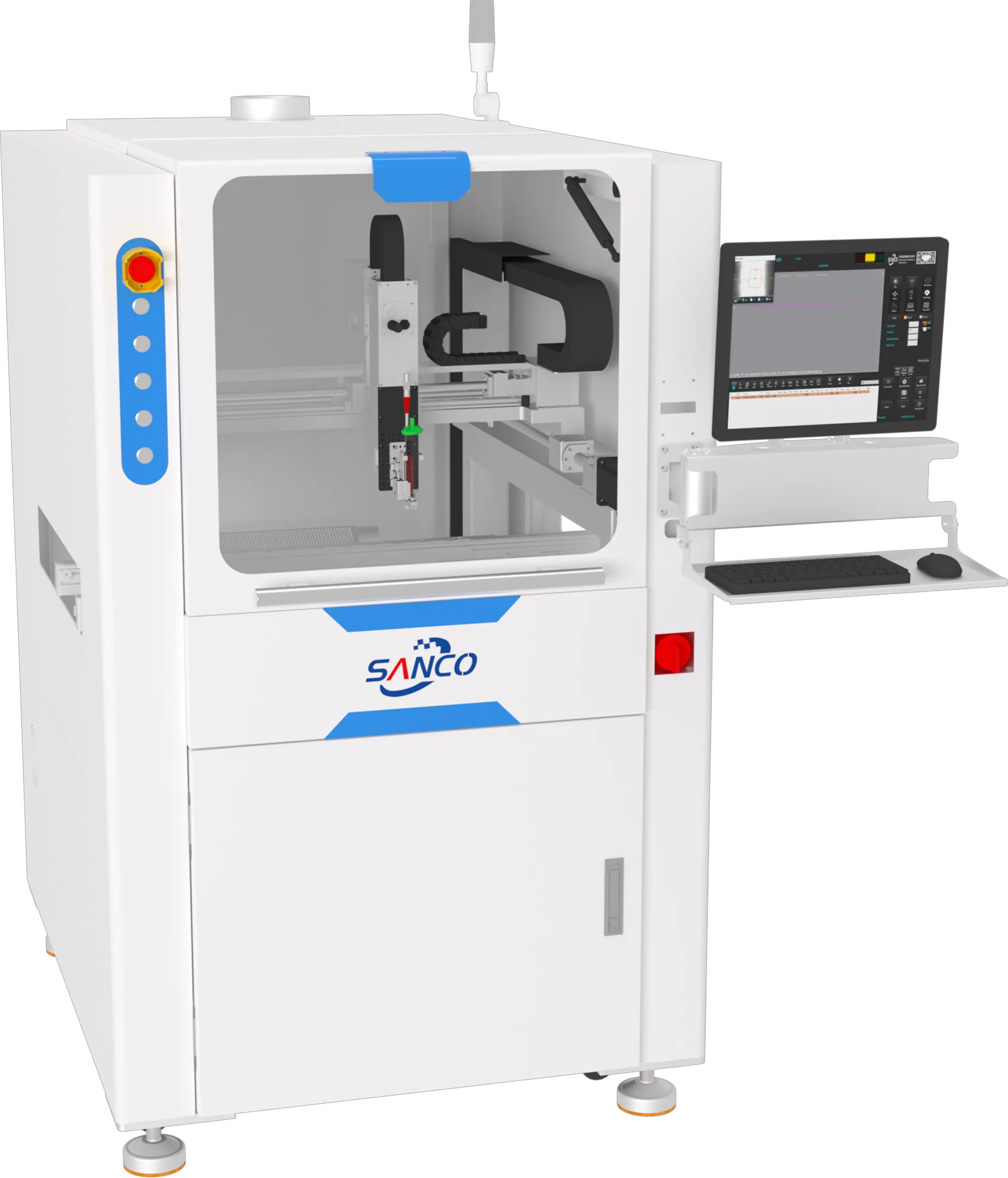
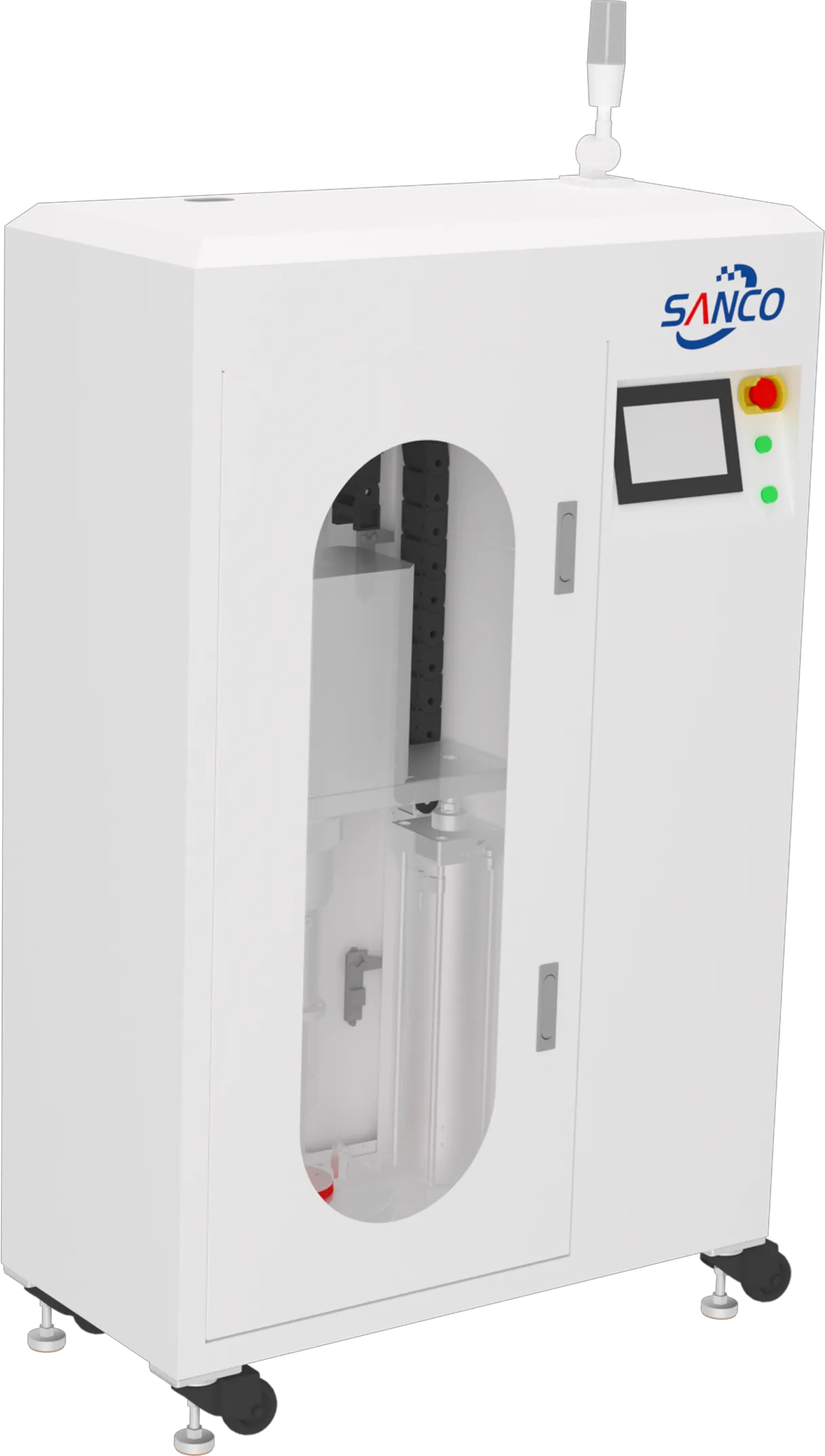
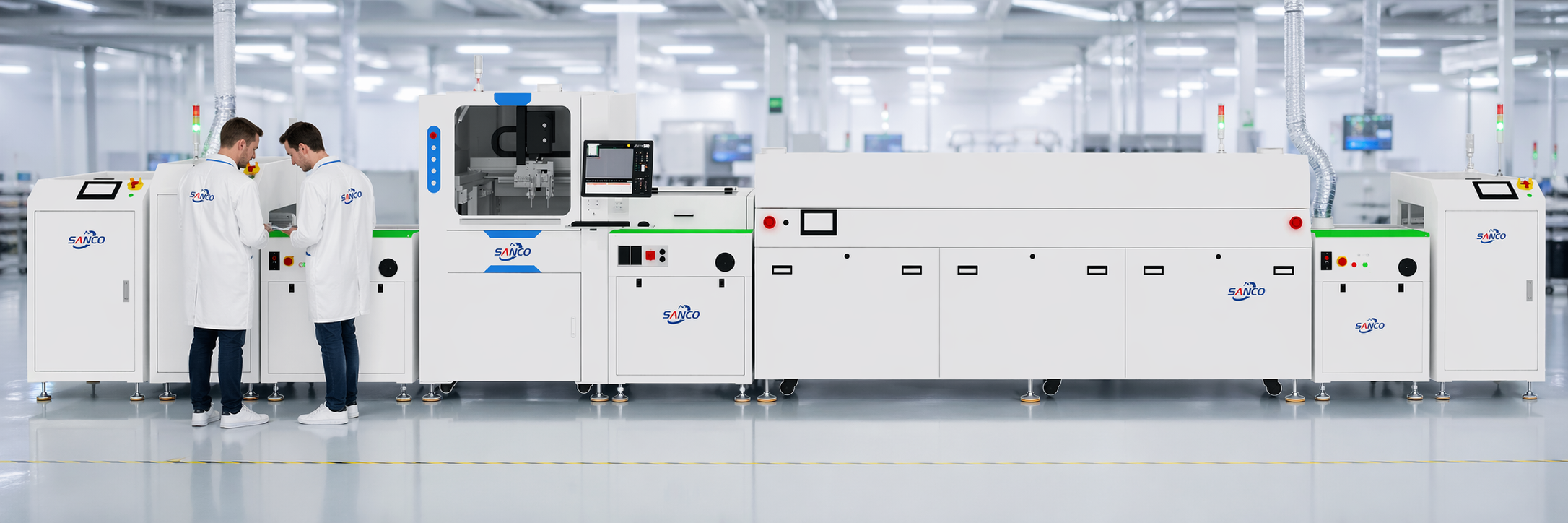
A complete automated solution may include a Four-Axis Coating Machine, UV-transportband, curing oven, inspection system, loader, unloader, and NG/OK sorting conveyor.
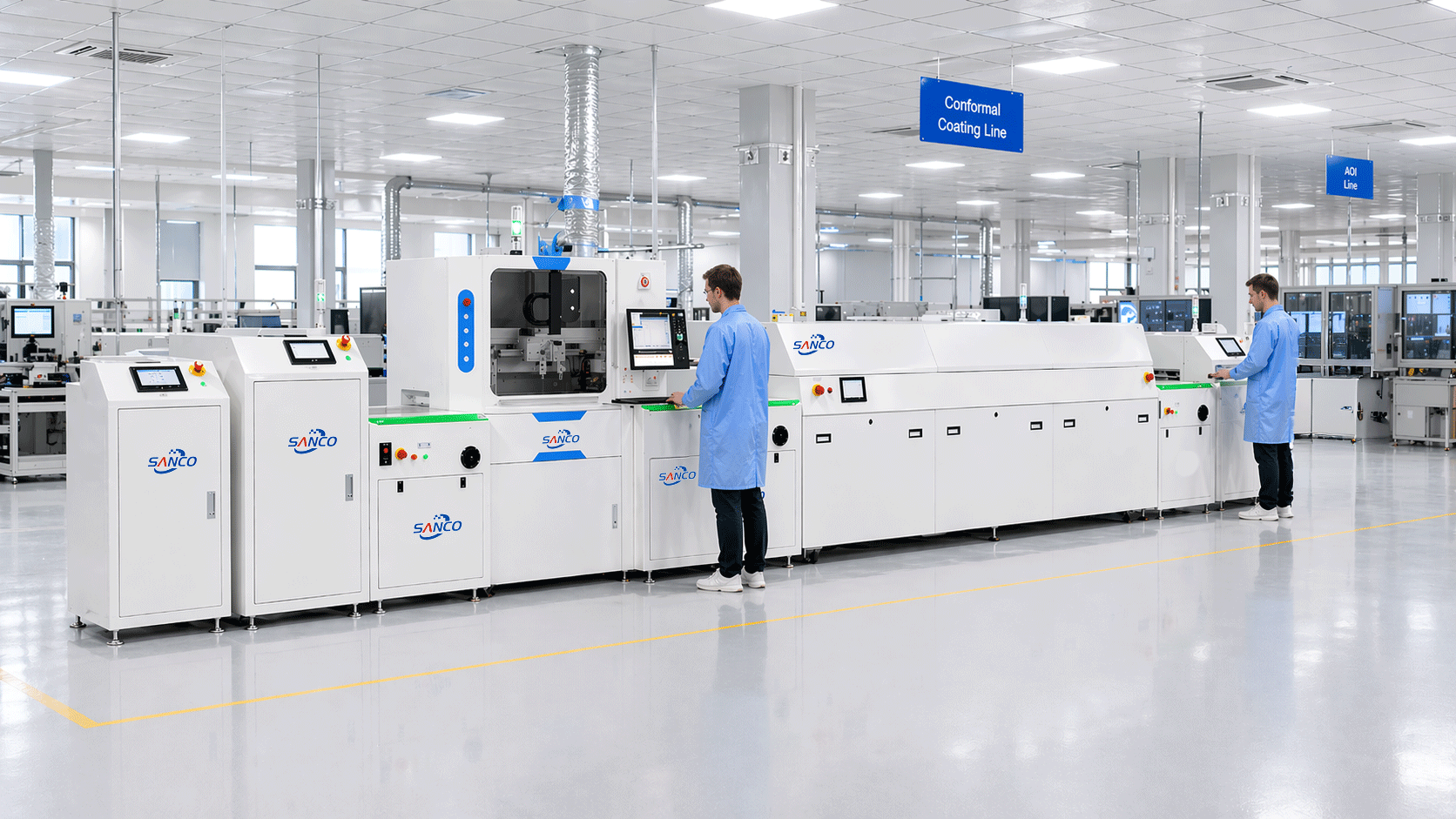
12. Inline Conformal Coating Line for PCBA Manufacturing
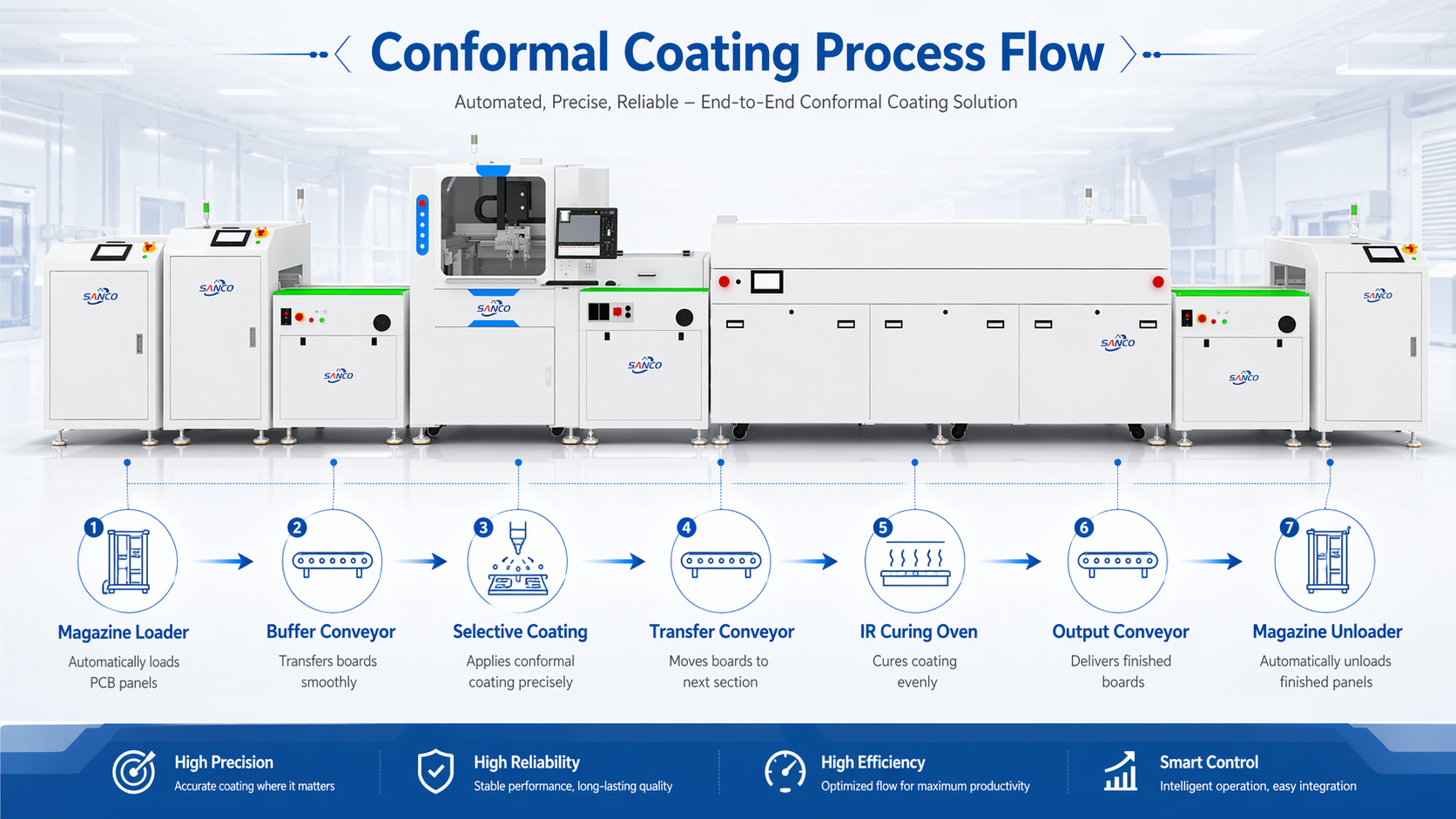
A complete conformal coating solution can include more than one machine. In many production lines, the coating process is integrated with handling, curing, inspection, and unloading systems.
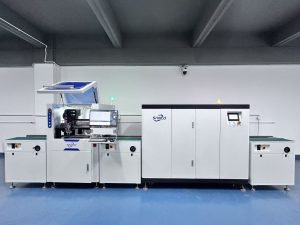
A typical inline conformal coating line may include an automatic Magazine Loader, Transportband, selective coating machine, IR droogoven or UV-uithardende oven, AOI inspection, NG / OK Conveyor, and Magazine Unloader.
For more complex lines, manufacturers may also use Elevators, PCB Flippers, Shuttle Conveyors, Vertical Buffer Conveyors, and Vertical Cooling Buffer Conveyors to improve automation and production continuity.
13. SANCO Conformal Coating and Dispensing Solutions
SANCO provides automated equipment and process solutions for PCBA conformal coating, dispensing, potting, curing, and production line integration.
Our solutions cover Doseermachine, Doseerkleppen, Coating Machine, Kleppen coaten, Oppotmachine, Hardingsoven, and inline automation peripherals.
| SANCO Solution | Toepassing | Recommended Link |
|---|---|---|
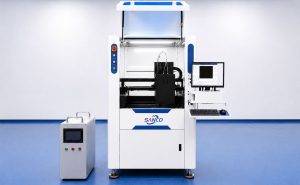
| Three-Axis Conformal Coating Machine | Standard selective coating process for PCBA production | View Product |
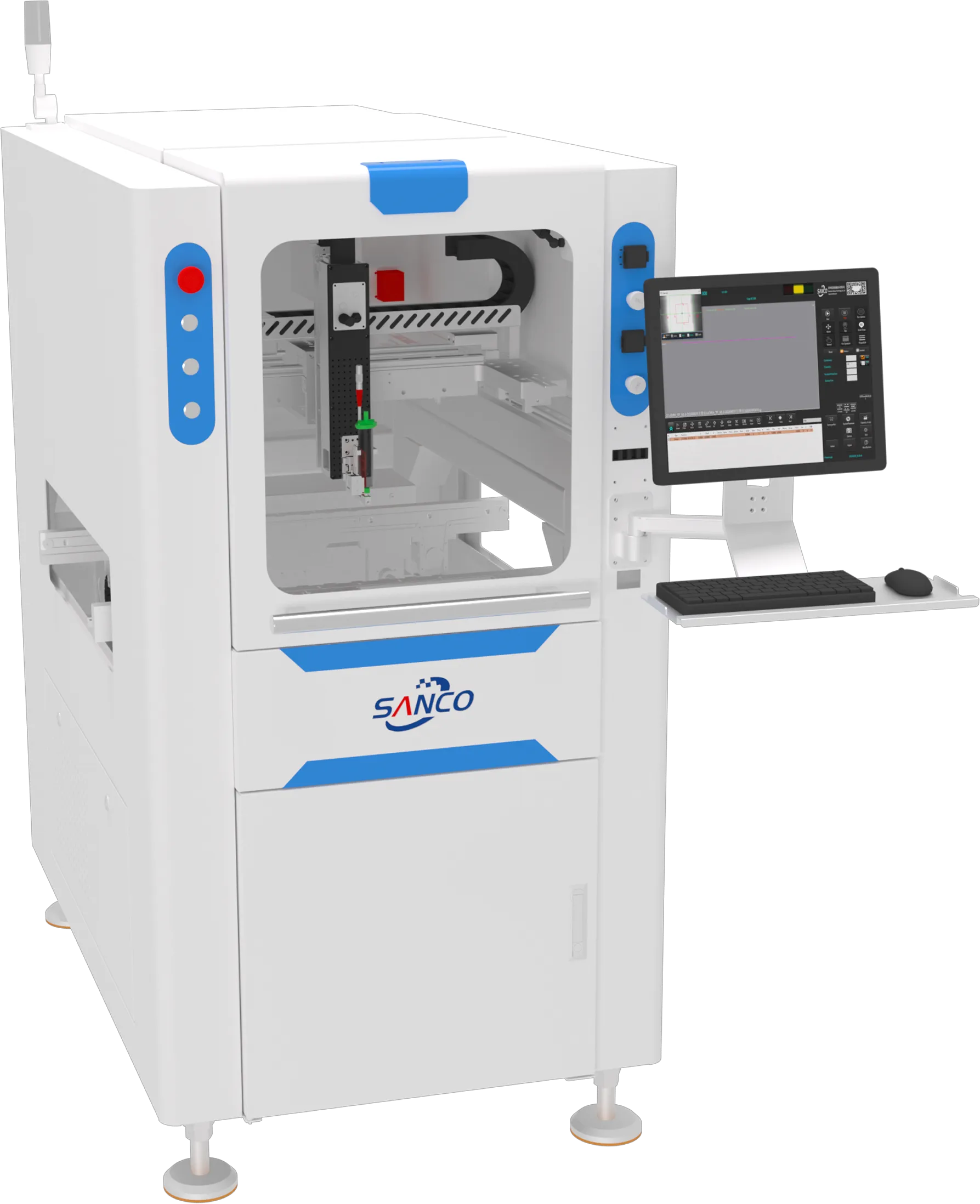
| Four-Axis Conformal Coating Machine | Flexible coating angle and complex PCBA applications | View Product |
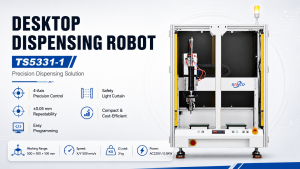
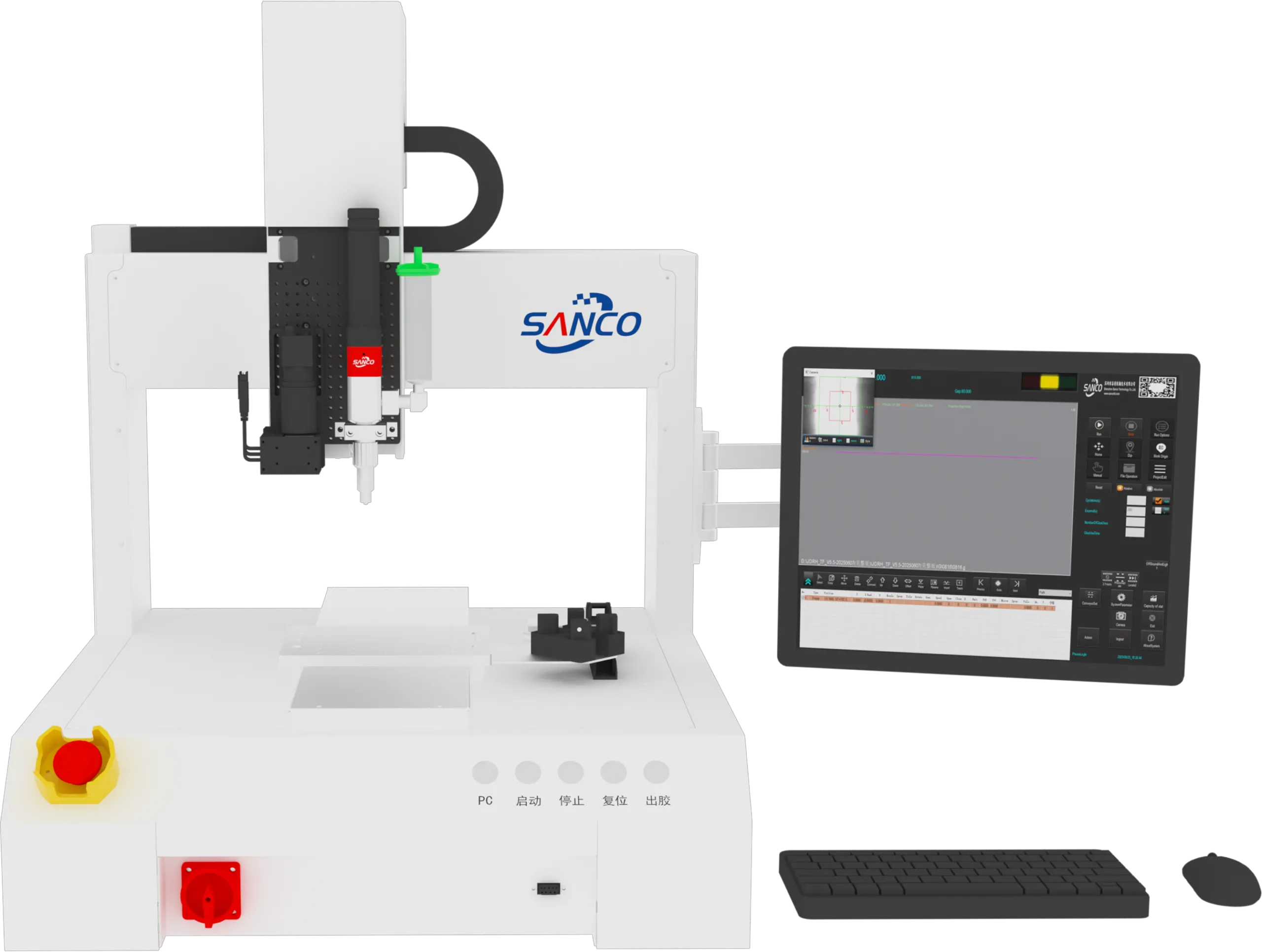
| Desktop coatingmachine | Small batch, laboratory, prototype, and flexible production | View Product |
| Inline PCBA Conformal Coating Line | Automated coating, curing, inspection, and handling line | View Solution |
| Dispensing and Potting Automation | Glue dispensing, sealing, potting, and fluid control applications | View Dispensing Machine |
14. Related SANCO Equipment Links
For different electronics manufacturing processes, you can also explore the following SANCO equipment categories:
Doseermachine
- High Speed Dispenser
- DS Series Inline High-Speed Dispensing Machine
- Offline High-Speed Dispensing Machine
- Desktop Visuele Doseermachine
- CANP 5G Pomp
Doseerkleppen
- Piëzo klep
- Piezo Jet Valve
- Piëzoventielregelaar
- Enkel vloeistofventiel
- Dubbele Vloeistof Schroefafsluiter
Kleppen coaten
- G-300HP hogedrukklep
- G-500HP membraanafsluiter
- BF-028 Filmspuitventiel
- SF-073 Sector Spuitklep
- G-420A precisieslagklep
- LF-001 Conisch Spuitventiel
Potting Machine and Curing Oven
- Inline oppotmachine
- Offline oppotmachine
- IR droogoven
- UV-uithardende oven
- Hete wind uithardingsoven
- UV LED droogoven
- Verticale oven
- Lead-Free Hot Air Reflow Ovens
15. Typical Industries Using Conformal Coating
Conformal coating is widely used in automotive electronics, industrial control, new energy electronics, home appliances, medical electronics, communication equipment, LED electronics, outdoor electronics, and power electronics.
These industries often require long-term PCBA protection against moisture, dust, salt spray, corrosion, vibration, and temperature changes. By using automatic selective coating equipment, manufacturers can improve coating consistency, reduce manual errors, and build a more stable production process.
Conclusion
The conformal coating process plays a critical role in protecting PCBAs from moisture, dust, salt spray, corrosion, and electrical failure. A successful coating process requires more than choosing the right coating material. It also depends on proper cleaning, accurate coating, controlled curing, inspection, and keep-out area management.
For modern electronics manufacturing, automatic selective conformal coating equipment is becoming the preferred solution because it provides higher precision, better consistency, lower material waste, and stronger production efficiency.
If your production requires reliable PCBA protection, SANCO can provide conformal coating machines, curing systems, dispensing machines, potting machines, and complete inline automation solutions based on your process requirements.
FAQ
What is the purpose of conformal coating?
The purpose of conformal coating is to protect PCBAs from moisture, dust, corrosion, salt spray, chemical contamination, and electrical leakage. It helps improve product reliability and service life.
Which conformal coating method is best for mass production?
For mass production, automatic selective conformal coating is usually the best choice. It provides higher accuracy, better consistency, reduced masking work, and improved production efficiency.
What areas should not be coated on a PCBA?
Connectors, switches, sockets, test points, screw holes, heat sinks, LEDs, optical components, and some high-power components should usually not be coated.
Why does conformal coating produce bubbles?
Bubbles may be caused by moisture, surface contamination, trapped air, high humidity, incorrect coating speed, or improper curing conditions.
Can SANCO provide a complete conformal coating line?
Yes. SANCO can provide single conformal coating machines as well as complete inline coating solutions including coating, curing, inspection, conveyors, loaders, and unloaders.